Pro Monthly
NT$120
Auto-renews monthly
Pro Monthly
Japanese · Handwriting
One character a day, written by hand until it sticks
Free download · see plansYou can read Japanese but cannot write it, and your stroke order is a guess. Most writing apps hand out three stars and never tell you which stroke was wrong. Hitofude checks every stroke you draw and says what is off, from hiragana to everyday kanji, one character a day. It supports finger and Apple Pencil, and your writing tree grows as you practice. It is offered on the Taiwan App Store and Google Play, and the interface is Traditional Chinese only.
Swipe for more
For learners who want to actually write the kana, not just recognize them; for people whose kanji look "off" but cannot say why; for hand-writers who remember better by writing, or who are preparing for a Japanese exam; and for anyone who knows a character but is unsure which stroke comes first. No experience needed, start from the first kana.
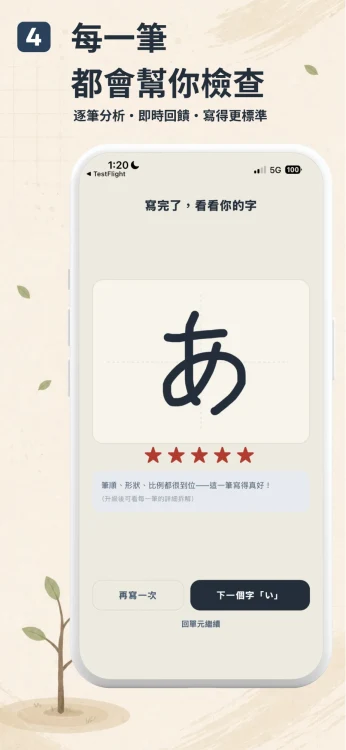
Reading Japanese but being unable to write it, with stroke order always unclear, is a common sticking point. Hitofude compares each stroke: the stroke count, where each one starts and which direction it runs, the shape and proportion, and how steady the line is. It tells you exactly where you went wrong instead of a vague "keep going."
Hitofude does not give you three stars and move on. The app compares each stroke you write: stroke count, starting position and direction of each stroke, the shape and size of the character, and how steady your line is (with built-in hand-tremor detection). When you make a mistake, it points to the stroke that is wrong, so you know what to fix next time. After upgrading, you can also see a detailed stroke-by-stroke breakdown.
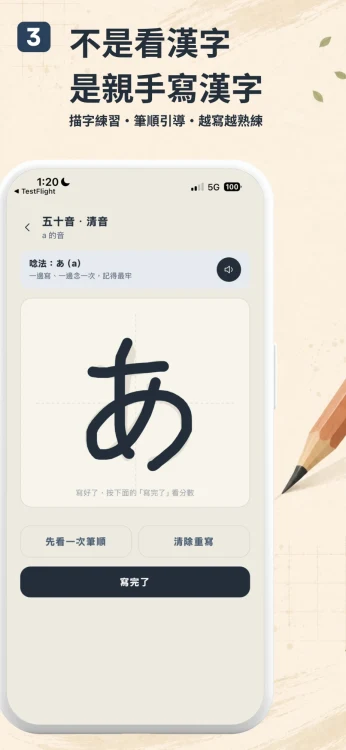
Tracing has three stages. For the first two tries you trace a full template, on the third and fourth the template fades, and after that it disappears and you write from feel and memory. You never depend on the template forever, and you never face a blank page too early. If you forget the order, tap "Show stroke order once" and replay strokes one, two, three. Both finger and Apple Pencil work.
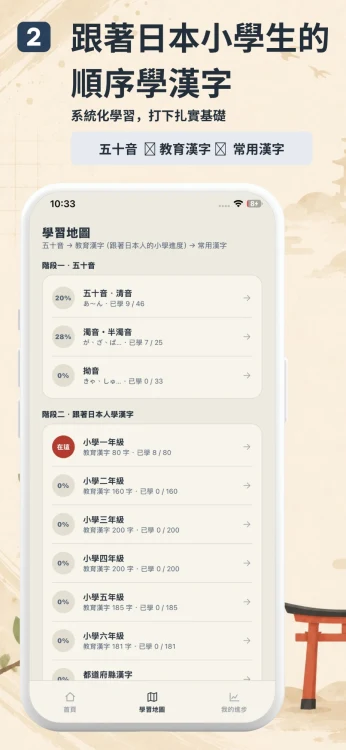
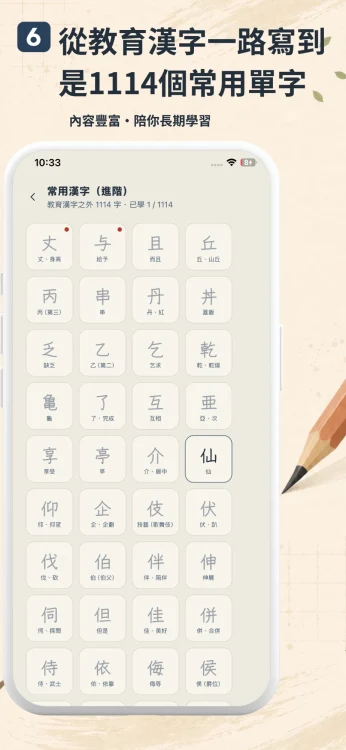
The content has three stages. Stage one is kana: basic, voiced and semi-voiced sounds and contracted sounds. Stage two is the educational kanji, 1,006 characters from first through sixth grade, plus the kanji used in the names of the prefectures. Stage three is the 1,114 jōyō kanji beyond the educational set. Each character has its reading, a Chinese meaning and example words with other readings, and characters made in Japan (wasei kanji) are marked.
You do not have to decide what to write. Hitofude schedules five characters each day, mixing new characters and ones due for review, records them when you finish, and picks up tomorrow. That removes the "what should I practice today?" excuse and makes daily writing a small, low-effort habit.
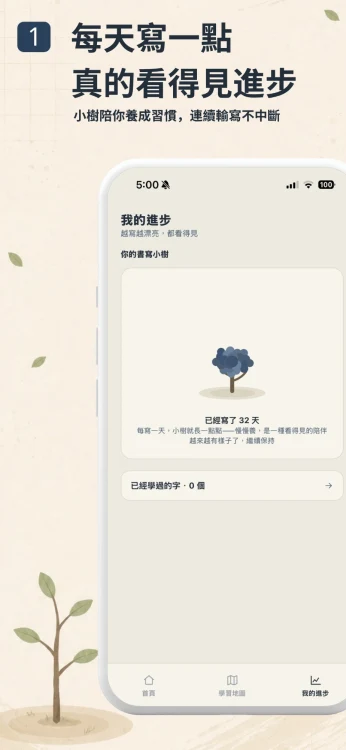
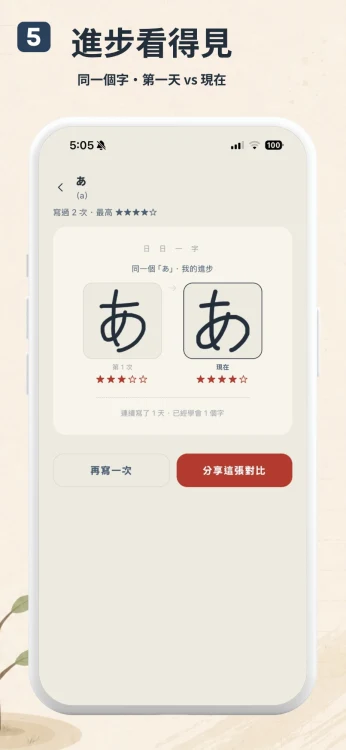
Your practice becomes visible progress. A writing tree grows a little each day you write, and a handwriting comparison puts the first time you wrote a character next to today's, so improvement is something you can see. Streak days, characters written and current progress are all on one screen, and you can turn your progress into an image to share.
Besides kana and kanji, Hitofude includes themed practice sheets. The "Confession and Dating Phrase Pack" has 40 Japanese love phrases with pronunciation, in 6 situations such as confessing, being sweet, missing someone and anniversaries. Some things are hard to say out loud, so write them out stroke by stroke. Finish all 40 and a hidden bonus line awaits. It needs no subscription and is a one-time purchase that is yours permanently.
Hitofude is free to download. Pro offers monthly and yearly auto-renewing subscriptions, and the Confession Phrase Pack is a one-time purchase. iOS: Pro Monthly NT$120, Pro Yearly NT$990, Confession Phrase Pack NT$150; Android: Pro Monthly NT$120, Pro Yearly NT$990, Confession Phrase Pack NT$150.
| Plan | Price | Purchase type | Includes |
|---|---|---|---|
| Pro Monthly | NT$120 | Auto-renews monthly | Pro Monthly |
| Pro Yearly | NT$990 | Auto-renews yearly | Pro Yearly |
| Confession Phrase Pack | NT$150 | One-time purchase | Unlocks the confession phrase content |
NT$120
Auto-renews monthly
Pro Monthly
NT$990
Auto-renews yearly
Pro Yearly
NT$150
One-time purchase
Unlocks the confession phrase content
Content last updated:
Not yet. The in-app interface is currently in Traditional Chinese only, and the app is offered on the Taiwan App Store and Google Play rather than the US or Japan stores. The writing practice itself is Japanese kana and kanji.
The free version fully covers kana (basic, voiced and semi-voiced sounds and contracted sounds) and the 80 first-grade educational kanji. Grades two to six, the prefecture kanji and the 1,114 jōyō kanji unlock after upgrading.
Yes. Hitofude supports both finger and Apple Pencil, and writing with your finger is scored as normal.
It compares each stroke for stroke count, the starting position and direction of each stroke, the character's shape and proportion, and whether the line is steady, and it points out which stroke has a problem. After upgrading you can see a detailed breakdown of every stroke.
Sushi JLPT focuses on memorizing and reviewing JLPT vocabulary. Hitofude focuses on hand-writing and stroke order, from kana to everyday kanji. The two have different goals, so they can be used together.
No. Hitofude needs no sign-up or login, so you can start writing right away. After upgrading, you can optionally turn on iCloud backup to save your learning records.
Not necessarily. Being able to recognize and hear them comes first, and handwriting is a bonus that helps you remember shapes. Longcamp et al. (2005) taught children aged 3 to 5 letters, and the handwriting group scored higher on later recognition than the typing group, but the subjects were young children, not Japanese learners, and later results are mixed. Try this: 1. Make sure you recognize each kana. 2. Write easily confused characters (such as ぬ/め or わ/ね) while saying them aloud. 3. Spread short sessions over several days, which usually helps memory more than one long session (Cepeda et al., 2006). Hitofude checks your strokes from kana onward, with finger or Apple Pencil.
Yes, but do not obsess. Japanese schools follow the Ministry of Education's 1958 "Hitsujun Shidō no Tebiki" to standardize how educational kanji are taught, to avoid confusion, not to deny other accepted ways of writing; characters such as 上 and 点 also have more than one common stroke order. Try this: 1. As a beginner, stick to one standard order. 2. Watch the stroke order, then trace. 3. For characters with several accepted orders, do not agonize. A 2025 experiment with Chinese learners found that people who wrote in the correct order wrote and recognized characters faster, but that does not necessarily carry over to Japanese kanji. Hitofude guides your stroke order and checks each stroke.
Related articles.
Hitofude · Free download
Download and try it