KOKO PRO Monthly
NT$150
Auto-renews monthly
KOKO PRO monthly subscription

Japanese · Everyday Speaking
Open the app, you are in Japan — 100 days to speaking Japanese
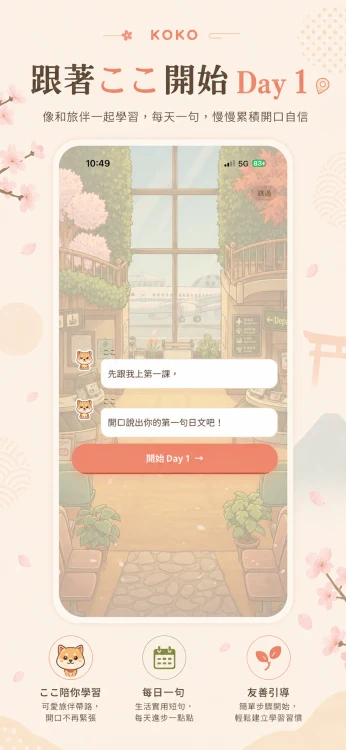
Free download · see plansYou studied the grammar rules, but when a real person speaks to you, your mind goes blank. KOKO skips the jargon and puts you inside real situations: asking for directions at a station, paying at a convenience store, walking into an izakaya. Across 10 scenes and 100 lessons, a Shiba Inu buddy keeps you company for five minutes a day until you can actually speak. The in-app interface is currently Traditional Chinese only.
Swipe for more
For people about to travel to or live in Japan, learners who know quite a few words but freeze in front of real people, and complete beginners who want to learn Japanese conversation step by step through real scenes such as stations, restaurants and izakaya instead of only memorizing vocabulary.
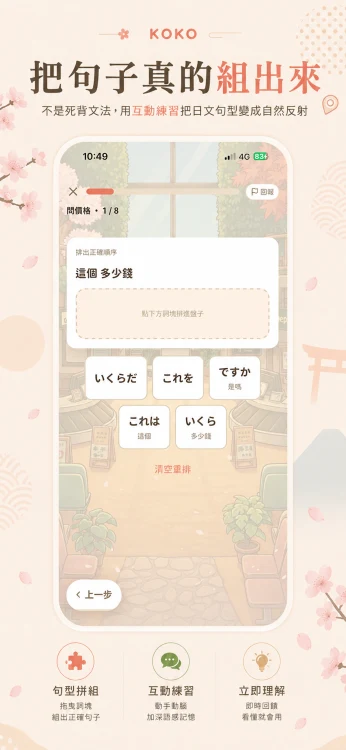
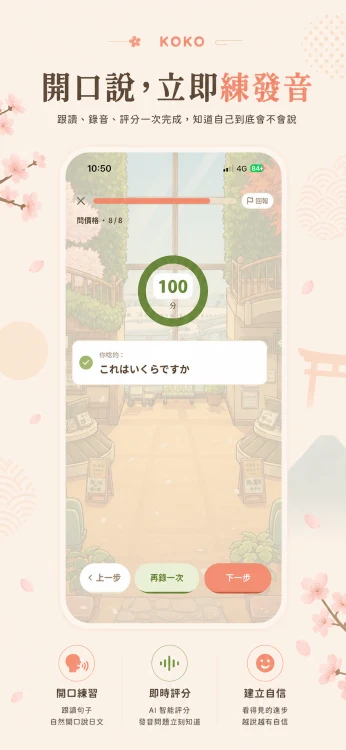
Memorized grammar but blank when someone speaks, unsure which pattern to use? KOKO drops you into scene dialogues, and sentence rebuilding, tense changes and shadowing with pronunciation feedback repeat until the line becomes Japanese you can really say, not just an exam answer.
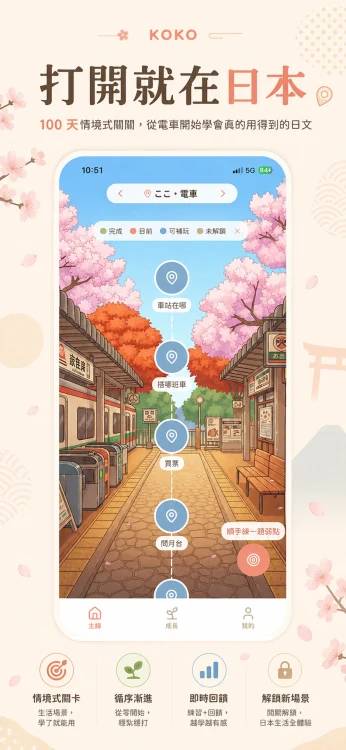
Start by clearing immigration at Narita Airport, then ride the train, shop at a convenience store, order at a restaurant, stay at a hot spring inn, browse a shopping street, visit a shrine and step into an izakaya. Ten chapters and 100 scenes, each one a conversation you will really meet in Japan, not a textbook sentence you forget.
Each lesson revolves around one key sentence. A story sets the scene (NPCs even call you by name), then you rebuild the sentence, practice tense changes, and shadow it with instant pronunciation comparison. Finally, a boss stage gives you the meaning in Chinese and asks you to produce the Japanese with no hints. Finish all five steps and the sentence is yours.
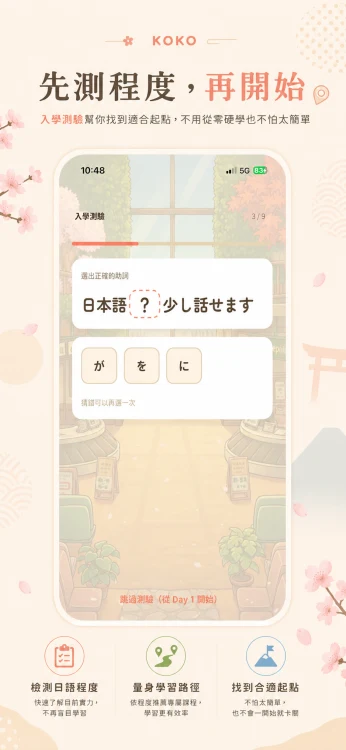
The first time you open the app, a 9-question placement test finds chapters you already know and lets you skip them. If you forget a grammar point midway, the grammar review center is always one tap away, so you never have to restart from lesson one.
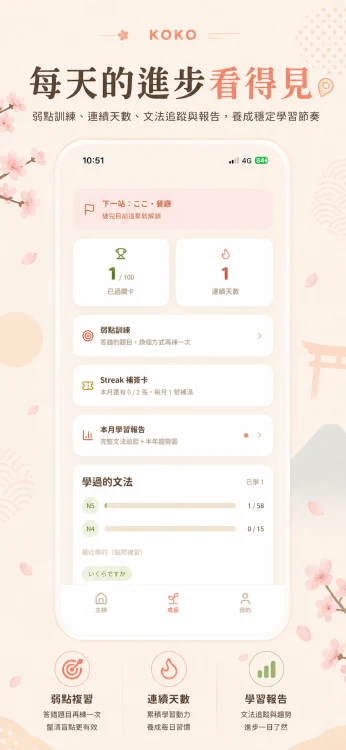
Questions you miss are recorded and asked again in a different format, and they leave the list only once you get them right. A monthly report shows what is solid and what needs work. Weak-spot training can be used once a week on the free plan.
All 100 lessons map to JLPT N5–N4 grammar points and were reviewed chapter by chapter by native Japanese speakers before release. A short quiz ends each chapter. The interface is entirely in Traditional Chinese, designed for learners in Taiwan, and it suits anyone preparing for the beginner JLPT levels.
The first chapter is free, and 2 new lessons unlock free each day, so you can keep learning without paying up front. KOKO PRO removes ads, unlocks unlimited weak-spot training and the full monthly report, adds 2 Streak makeup cards a month and cloud backup of your progress. It comes in monthly and yearly plans. iOS: KOKO PRO Monthly NT$150, KOKO PRO Yearly NT$990; Android: KOKO PRO Monthly NT$160, KOKO PRO Yearly NT$1040.
| Plan | Price | Purchase type | Includes |
|---|---|---|---|
| KOKO PRO Monthly | NT$150 | Auto-renews monthly | KOKO PRO monthly subscription |
| KOKO PRO Yearly | NT$990 | Auto-renews yearly | KOKO PRO Yearly |
NT$150
Auto-renews monthly
KOKO PRO monthly subscription
NT$990
Auto-renews yearly
KOKO PRO Yearly
| Plan | Price | Purchase type | Includes |
|---|---|---|---|
| KOKO PRO Monthly | NT$160 | Auto-renews monthly | KOKO PRO monthly subscription |
| KOKO PRO Yearly | NT$1040 | Auto-renews yearly | KOKO PRO Yearly |
NT$160
Auto-renews monthly
KOKO PRO monthly subscription
NT$1040
Auto-renews yearly
KOKO PRO Yearly
Content last updated:
Yes. KOKO starts with the very first Japanese sentence on Day 1. If you already know some, take the 9-question placement test and skip the chapters you have mastered.
The first chapter is free, and 2 new lessons unlock free each day. KOKO PRO is an auto-renewing monthly or yearly subscription: iOS: KOKO PRO Monthly NT$150, KOKO PRO Yearly NT$990; Android: KOKO PRO Monthly NT$160, KOKO PRO Yearly NT$1040.
Not yet. The in-app interface is currently in Traditional Chinese only, while the lessons teach Japanese. If you can read a Traditional Chinese menu, you can use it to learn Japanese conversation.
KOKO PRO removes ads, gives unlimited weak-spot training (the free plan allows 1 use per week), shows the full monthly learning report, adds 2 Streak makeup cards per month and backs up your progress to the cloud.
They come from the same team. Sushi JLPT is for JLPT vocabulary, Ninja Pigeon for listening and grammar question types, and KOKO puts Japanese into real-life scenes so you practice speaking. Use all three to strengthen different skills.
The 100 lessons map to JLPT N5–N4 grammar points and were reviewed chapter by chapter by native Japanese speakers. It suits learners preparing for beginner JLPT levels who also want to practice speaking.
It is available on iOS and Android. iOS requires version 16.4 or later. The interface is entirely in Traditional Chinese, designed for learners in Taiwan.
Start with situations you meet every day: transportation, shopping and dining, self-introduction, plus basic phrases for emergencies. The Japan Foundation's "JF Standard Can-do for Life in Japan" targets people living in Japan and lists 381 items covering transportation, shops and workplaces. Steps: 1. Memorize whole sentences for asking directions, paying and ordering. 2. Practice understanding short replies, not just asking. 3. Add self-introduction and ways to ask for help. KOKO's 10 scenes and 100 lessons, from station directions to convenience store checkout to the izakaya, have you rebuild sentences and shadow them.
Often you only practiced recognizing, not producing. Turn output into a small daily routine. 1. Memorize whole sentences placed in scenes, such as paying or asking for directions, not isolated words. 2. Shadow out loud, listening and repeating so your mouth gets used to the rhythm. 3. Swap one or two words each time, such as the tense or the person, to confirm you are not just memorizing. Shadowing is widely used in language teaching, but direct research on Japanese speaking is limited, so this is a practical method. KOKO's sentence rebuilding, tense changes and shadowing follow exactly this routine.
Related articles.
KOKO · Free download
Download and try it