Unlock Full Course
NT$150
One-time purchase
Unlock Full Course
Divination · Qimen Dunjia Basics
One concept in 3–5 minutes a day, one Qimen seal at a time
Free download · see plansQi Men Dun Jia throws a long list of terms at you before you even begin: the five elements, heavenly stems, earthly branches, eight gates, eight deities and nine stars, all tangled together. You read for hours, miss the point and give up halfway. Qimen Yinpu splits the basics into one idea a day: read a short card, answer a few questions and collect a seal. It is a learning app, not fortune telling and not a chart-casting tool. The in-app interface is currently Traditional Chinese only.




Swipe for more
For people curious about Qi Men Dun Jia who get stuck on basic terms like the five elements, heavenly stems, earthly branches, eight gates, eight deities and nine stars; for people who bought a book or watched tutorials and gave up memorizing; and for those who want to build a foundation a few minutes a day, not jump straight into casting charts. No prior knowledge needed; you start with the five elements' generating and overcoming cycles.
Just getting started with Qi Men Dun Jia means remembering the five elements, heavenly stems, earthly branches, eight gates, eight deities and nine stars, with so much material tangled together that you search for hours and still miss the point. Qimen Yinpu breaks the basics into one idea a day: read a short card, do a few small questions, and collect the matching seal, so the abstract becomes progress you can see.
Qimen Yinpu does not dump the five elements, heavenly stems and earthly branches on you all at once. Each lesson is a short set of cards you can read in 3 to 5 minutes, explaining one specific small idea. For example, the fire lesson tells you wood generates fire and fire generates earth, and also that fire overcomes metal and water overcomes fire. You do not need to get through a whole book; open a lesson on your commute, before bed or in a queue.
Learning has two steps. First you understand the concept, then small questions confirm you really understood it, instead of assuming you have learned it after reading cards. After each set of short cards come a few easy practice questions that make you think the idea through again. The point is not an exam but a second pass to make sure the concept stayed with you.
The hardest part of starting is knowing where to begin with the five elements, heavenly stems, earthly branches, eight gates, eight deities and nine stars. Qimen Yinpu turns these six topics into a "learning journey" map, starting at the Five Elements Garden and moving station by station through heavenly stems, earthly branches, the nine palaces and more. Total progress (for example 9/69) shows at the top and each station shows its own progress (for example heavenly stems 2/12), so you can see where you are at a glance.
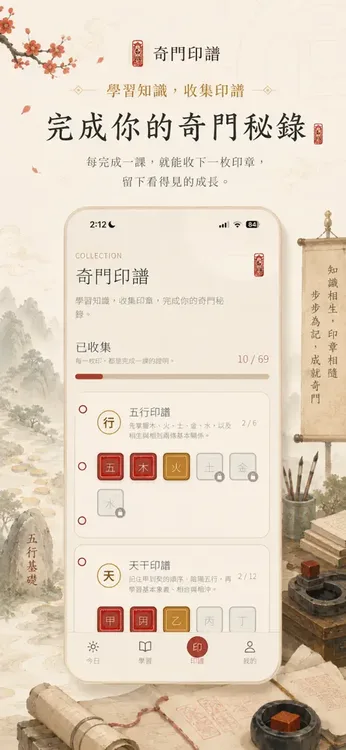
The special part is that your learning becomes seals you can see. Each completed lesson earns a seal; finish the Open Gate lesson and you receive an Open Gate seal, finish how fire generates and overcomes and you receive a fire seal. There are 69 in total, including 6 for the five elements and 12 for the heavenly stems, while seals for other topics unlock as you move along the journey. The collection page shows "collected x/69," and each seal is proof that you finished a lesson.
Open the app and the Today page tells you what "today's lesson" is and roughly how long it takes (for example about 3 minutes, 5 cards); tap in to continue, with no need to decide what to read. It also shows chapter progress (for example Five Elements Basics 2/6) and the seals you collected most recently. The bottom has four tabs: Today, Learn, Seals and Me. Today takes you into the day's lesson, Learn shows the full journey map, and Seals holds every seal you have collected.
Qimen Yinpu is free to download, and basic topics such as the five elements and heavenly stems can be studied free. The full course, including earthly branches and the nine palaces, unlocks with a one-time purchase: iOS: Unlock Full Course NT$150; Android: Full Version Unlock NT$160. Final prices are shown in the store.
| Plan | Price | Purchase type | Includes |
|---|---|---|---|
| Unlock Full Course | NT$150 | One-time purchase | Unlock Full Course |
NT$150
One-time purchase
Unlock Full Course
| Plan | Price | Purchase type | Includes |
|---|---|---|---|
| Full Version Unlock | NT$160 | One-time purchase | Unlock Full Course |
NT$160
One-time purchase
Unlock Full Course
Content last updated:
No. Qimen Yinpu is a beginner learning app for Qi Men Dun Jia. It helps you understand basics such as the five elements, heavenly stems, earthly branches, eight gates, eight deities and nine stars. It is not a fortune-telling tool and does not cast charts or interpret them.
Not yet. The in-app interface and lesson text are currently in Traditional Chinese only. If you can read Traditional Chinese, you can use it to study Qi Men Dun Jia basics.
Yes. Qimen Yinpu starts from the basic generating and overcoming cycles of the five elements, and every lesson is a short set of cards you can read in 3 to 5 minutes. You do not need any background; just follow the learning journey station by station.
It is free to download, and basic topics like the five elements and heavenly stems are free to start. The full course is a one-time purchase: iOS: Unlock Full Course NT$150; Android: Full Version Unlock NT$160.
Each lesson takes about 3 to 5 minutes: read short cards and do a few small questions. Completing a lesson earns a seal; finish the Open Gate lesson and you get an Open Gate seal, finish how fire generates and overcomes and you get a fire seal.
Six beginner topics are covered: the five elements, heavenly stems, earthly branches, eight gates, eight deities and nine stars. Collecting everything gives 69 seals, including 6 for the five elements and 12 for the heavenly stems, and the rest unlock along the learning journey.
Qimen Yinpu supports iOS (App Store, iOS 16.4 or later) and Android (Google Play). The interface is in Traditional Chinese, and both platforms are free to download.
Qi Men Dun Jia is a traditional Chinese system of divination that, together with Da Liu Ren and Tai Yi Shen Shu, makes up the "Three Styles," based on the Luoshu, the nine palaces with the eight trigrams and the generating and overcoming of the five elements (according to Wikipedia). In the name, "Qi" refers to the three wonders (the stems yi, bing and ding), "Men" to the eight gates, and "Dun Jia" means that jia is hidden beneath the six instruments. A beginner can go in this order: 1. Learn the five elements' generating and overcoming cycles. 2. Learn the heavenly stems and earthly branches, since the three wonders and six instruments are made of stems. 3. Then learn the eight gates, nine stars and eight deities, and only after that move on to charts. Qimen Yinpu is a beginner learning app that does not tell fortunes or cast charts: you read a concept card and do a few questions each day.
The eight gates are the Rest, Life, Harm, Delusion (Du), Scenery, Death, Fear and Open gates. In the traditional view, Open, Rest and Life are auspicious gates, Death, Fear and Harm are inauspicious, and Du and Scenery are neutral; this is a classification from traditional divination and has not been scientifically verified. The eight gates, together with the nine stars, eight deities and nine palaces, make up the chart. Steps: 1. Learn the names and categories of the eight gates. 2. Learn the names of the nine stars and eight deities. 3. Only then learn how they are arranged across the nine palaces. Qimen Yinpu breaks topics such as the eight gates into short lessons, and finishing the Open Gate lesson earns an Open Gate seal.
Related articles.
Qimen Yinpu · Free download
Download and try it